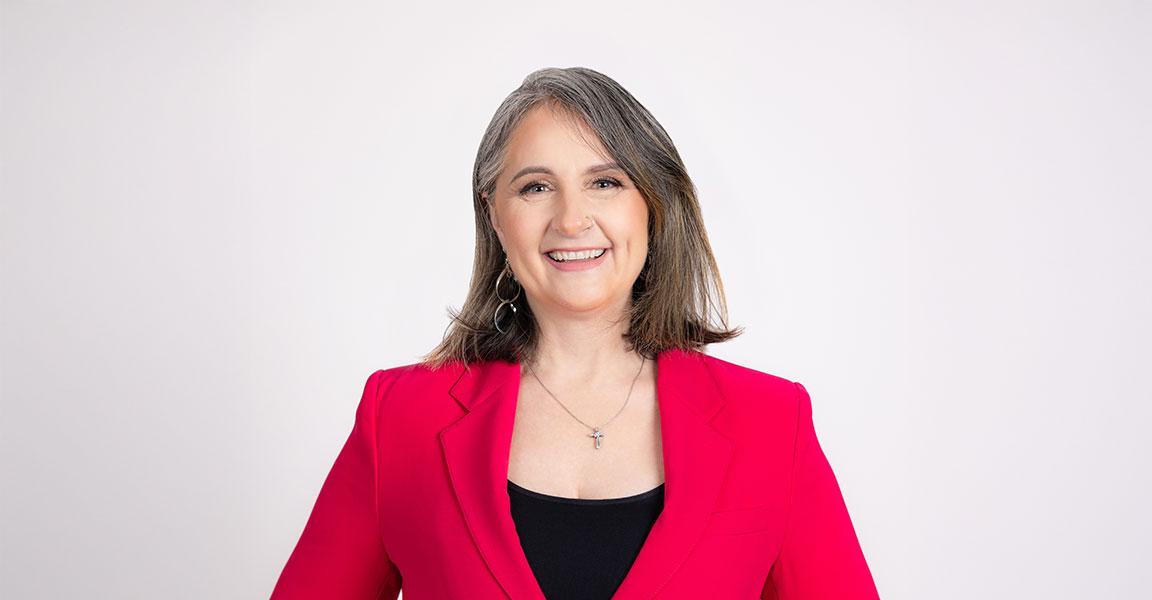
Some women spend decades searching for their purpose, while others discover it in the most unexpected detours. The most compelling stories often begin when childhood dreams collide with reality, forcing a choice between the safe path and the unknown. For those brave enough to venture into uncharted territory, the journey of supporting the next generation becomes both deeply personal and profoundly transformative. Ashley Poklar, a psychologist, educator, and mother of four, captures this essence as the Clinical Director of Sentinel Foundation and founder of A Poklar Ponders.
For Ashley, that detour began with an unexpected change in high school that rerouted her childhood dream entirely. She laughs when she remembers her original ambition. "I really wanted to be a zoologist," she says, settling into her chair with the easy warmth that likely makes even the most guarded teenagers feel safe enough to open up. "I saw a special about Jane Goodall on Reading Rainbow when I was in second grade, and that was it for me. I wanted to live in the middle of nowhere with my children running around naked while I studied animals."
Living in Georgia at the time, Ashley had her entire academic path mapped out. She knew exactly which state school she would attend to pursue her zoology dreams. But when her family moved to South Carolina halfway through her tenth-grade year, everything changed. She discovered that not a single school in the state offered zoology programs. As a first-generation college student whose family couldn't afford out-of-state tuition, Ashley faced a crossroads that would reshape her entire future.
Finding Her Calling in the Margins
Needing extra credits, she enrolled in a teacher cadet class almost by accident, and something clicked. "I was like, I kind of like this." The class introduced her to the Teaching Fellows program, which offered exactly what a first-generation college student needed: full funding for college in exchange for staying in-state to teach. Ashley was accepted, but she wasn't content to play it safe.
True to what would become her pattern, she chose the hardest possible route. "I asked to be allowed to do my student teaching experience at the alternative school that nobody wanted to be at for anything, not even the small experiences." That decision changed everything. Ashley found herself in a dynamic classroom of 10 to 12 high school students with varying needs and abilities. These were the kids labeled as "bad," the ones who got kicked out of their schools. But Ashley saw something different. "Really, they were kids who faced trauma and their trauma gets the best of them."
She discovered she loved the challenge. "It was never boring. It was always interesting. It was always taxing my creativity. It was taxing my patience. It was forcing me to learn new skills." One particularly memorable day, a student poured chocolate milk on her head simply because Ashley asked her to sit down. "There was no guidebook. There was no perfect way to do it. And I really liked that part of it."
Through experiences like these, Ashley discovered what she loved most was the relational aspect: managing emotions, handling outbursts, connecting with students, and using those relationships to motivate learning. When she had her first daughter, she realized she couldn't be both the mom she wanted to be and the attachment figure that 10 really needy high school kids required. That realization led her back to school for her master's in counseling, focusing on the part of the work that truly called to her.
The Girl Who Changed Everything
After completing her master's in counseling and having three daughters, Ashley took an internship at the juvenile detention center. During her time there, Ashley encountered a 15-year-old girl who would fundamentally alter the course of her career. The girl was in jail for murdering a man who was abusing her and trying to abuse her girlfriend. "He was a well-liked man in the community. Nobody knew that he was doing that kind of thing," Ashley explains.
Working with this teenager, Ashley found herself advocating on her behalf to the psychiatrist, only to be dismissed as "a lowly intern" who didn't know what she was talking about. Her supervisor told her to accept her place at the bottom of the hierarchy. "I went home that night and applied for doctoral programs," Ashley says with a determined smile.
This case became a turning point in her understanding of systemic failure. "She opened my eyes to just how broken the system was. Working in these spaces, I knew it to some extent... but I really didn't start to see just how broken the systems are when it comes to the support that they provide or don't provide until my work with her."
Ashley began noticing patterns that troubled her deeply. Another girl kept cycling in and out of jail for prostitution. "The reality is a teenager can't be a prostitute. If somebody is paying them for sex, they're being raped, they're being trafficked." These experiences shattered her trust in systems she had believed would protect children.
Building Bridges Between Broken Systems
Ashley completed her doctorate while raising four children under the age of four. Through her journey, she identified a critical problem: " There’s a silo effect: education sits in one space, psychology in another, and parenting in its own separate corner. But there's so much knowledge that all three of those silos have that if they just shared a little bit of that knowledge, all of their jobs would be so much easier."
This insight drives her work today as Clinical Director of Sentinel Foundation and founder of A Poklar Ponders. Sentinel Foundation focuses on anti-child trafficking and exploitation, but Ashley's role goes beyond rescue operations. "My role when I came in was unique to a traditional rescue organization. Let's think about what happens to the kids after. Let's check out where we're sending them before we rescue them so that we know that where we're sending them is appropriate."
The statistics are sobering: 80 to 90 percent of children who are trafficked end up back in exploitative situations within three years. Ashley works to change this by providing psychological assessments, training caregivers, and ensuring proper therapeutic supports are in place. She's particularly passionate about helping people understand trauma's impact. For instance, when adoptive parents are frustrated that their child hoards food, Ashley helps them understand: "They hoard food because they had food insecurity for the entire first five years of life. They don't know where their next meal is coming from. It just makes them feel safe to have a bag of chips under their bed."
A New Chapter in Self-Care
Ashley recently published "My Inner Compass: A Workbook and Planner for Purposeful Living," a guide that emerged from her work with social workers in Uganda who desperately needed tools to manage the trauma they witnessed daily. "They hear really tough stories all day, every day. They work at a sex and gender-based violence clinic," Ashley explains.
The book challenges conventional notions of self-care and what Ashley calls the "elusive bliss" that many people chase. "We talk about self-care like ‘go take a long bath, take the day off work.’ I mean, yes, but it's not going to fix the problem. You take a mental health day off from work, you have to go back to work the next day."
Rather than treating self-care as a band-aid for hard days, Ashley reframes it as "a way of living that maintains one's ability to face hard days." The workbook addresses the key components of burnout, including emotional exhaustion, cognitive exhaustion, cynicism, and reduced feelings of personal accomplishment, through both preventative and intervening activities.
"The purpose is to provide a buffer against the hard moments through daily routines that don't require significant time or money," Ashley says. "You can use 30 seconds to go and splash your face with cold water to reset. It doesn't always have to cost money or be time intensive."
The guide includes 52 weekly prompted journal pages and planner sections, designed to help readers incorporate meaningful self-care practices into their daily lives rather than waiting until they're already burnt out.
The Mountain Climber's Perspective
Ashley often uses the metaphor of mountain climbing to help women recognize their accomplishments. "You climb one mountain and it's the hardest thing that you've ever done in your life... And then you get to the top and you look out and there's like four more mountains to climb and they're all higher."
"When we're in the process of climbing those mountains, we forget all of the mountains that we already climbed. All we're thinking about is I can't, I'm never going to get to the top of this one." She encourages women to stop and celebrate wins, even if it's just brushing their teeth and hair on a difficult day. "Sometimes it's okay for that to be the win for the day."
It's this same mountain-climbing mentality that drives Ashley's advice for women considering their own unconventional paths. Rather than staying on the well-traveled route, she advocates for exploring uncharted territory. "Don't let fear of the unknown keep you from exploring paths less traveled. Worst case, you hate it, and you get back on the main road. No big deal. You got some unique experiences that are going to make you a better person."
The key, Ashley believes, is embracing the inevitable discomfort that comes with growth. "Growth doesn't happen without discomfort. A lot of people stop leaning in as soon as they feel that discomfort, then they're frustrated that they don't see growth. But you're not going to find growth by sitting in what feels comfortable."
For Ashley, choosing the harder path has been worth every uncomfortable moment, not just for her own growth, but for every child who has been seen, understood, and supported because someone was willing to do the harder work of connecting broken systems.

Leave a comment
Your email address will not be published. Required fields are marked *