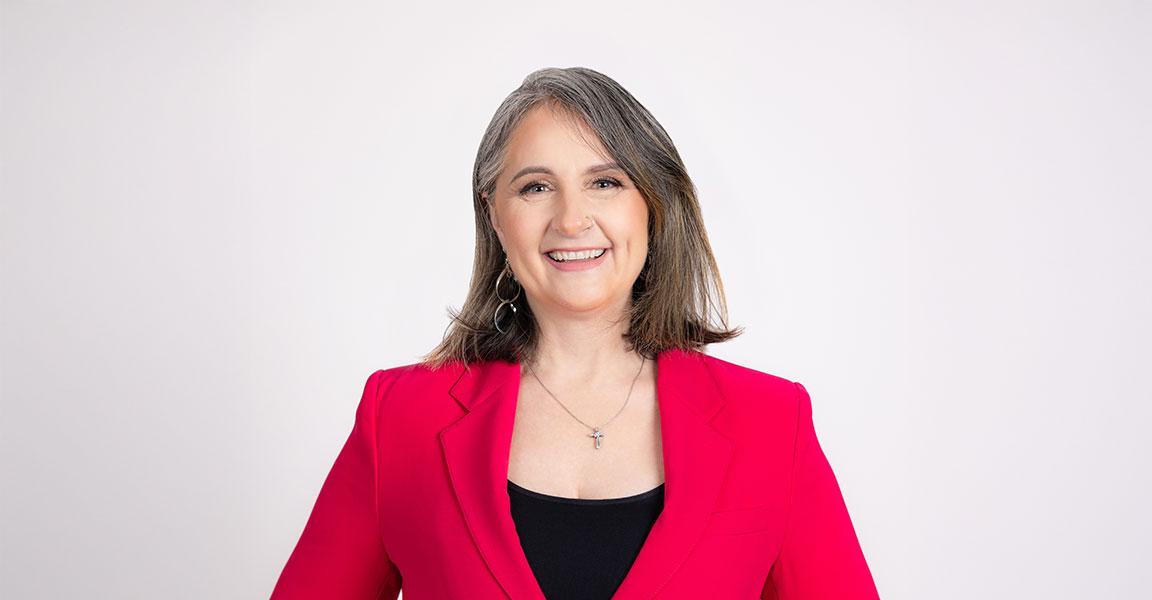
Sometimes the most profound career shifts happen when you start paying attention to what's missing rather than what's already there. Krista Rabidoux, Partner at Andersen LLP, built her 25-year career on noticing gaps and having the courage to fill them, even when that meant charting a path nobody had walked before.
In doing so, she's earned a reputation as someone who understands not just the numbers, but the people behind them. This distinction has become increasingly rare in an industry where most advisors stay locked in their lanes, running tax models and transaction scenarios without ever stopping to ask what their clients actually want to achieve.
The Accountant Who Never Planned to Be One
Krista's path to becoming a Partner at Andersen LLP wasn't exactly traditional. She started her career in the arts industry, working in concert production. It was creative and exciting; however, it would have kept her constantly on the road. Starting a family at a young age, she made a practical decision. She wanted something more stable, something that would keep her home instead of traveling from venue to venue.
She went back to school to become an accountant. Not because it was her lifelong dream, but because a professor told her she was good at it. Sometimes that's how life works. One comment, one observation, and suddenly you're on a completely different trajectory. One of those career moments where life circumstances demand a change, and you rise to meet it.
She became a designated accountant and found her way into cross-border tax work, handling both Canadian and US taxation. For years, she built a solid foundation in this area. She was good at it. Really good. But something was nagging at her. There was a conversation that wasn't happening, questions that weren't being asked, and families that were being left out of decisions that would completely reshape their lives.
The Gap Nobody Was Talking About
About ten years ago, Krista started to see it clearly. As accountants and lawyers, everyone was trained to solve problems. They would create plans, optimize tax positions, and develop strategies that looked perfect on paper. But there was one massive oversight: nobody was asking the families what they actually wanted.
She kept encountering the same scenario. Clients would come in with a request for some "sexy tax plan" they'd read about online or heard about from a friend. Accountants and lawyers would dutifully create that plan. But no one was stopping to ask: What's your five-year plan? What's your ten-year vision? Do your kids even want to be in the business?
The focus was always on tax efficiency, never on the impact these plans would have on the family itself. She watched as founders worked with advisors who never thought to include the next generation in the conversation. The children who would supposedly inherit or run these businesses had no voice in the planning process.
Building a New Approach
That's when Krista decided to do something about it. She took a coaching certification program, initially using it with her own employees and then with clients. She started asking different questions, digging deeper to figure out what people were really trying to achieve. Because here's the thing: just because a client says they want something doesn't mean they've actually thought through what that means for their life, their family, or their future.
Coaching taught Krista something that years of accounting education hadn't: the power of truly listening. "When I host family meetings, listening is about so much more than just hearing words," she says, leaning into the nuance of communication. "It's watching energy in the room, observing dynamics, noticing who's speaking and who isn't. It's understanding that what people say out loud is often just a fraction of what they're really communicating. Body language tells a completely different story sometimes. Someone tells you they're happy with a plan, but their posture says otherwise. Those are the moments where the real work begins."
This approach led her to pursue her Family Enterprise Advisor designation. She realized that if accountants and lawyers weren't asking clients the right questions, they definitely weren't thinking about what the next generation wanted. The entire system was set up to serve the founders, the current leaders, the ones signing the checks. But what about the children who would have to live with these decisions?
Now, Krista works within the whole ecosystem of family enterprise, which includes the family itself, the business operations, and the shareholdings or wealth. She helps families transition their businesses to the next generation, or figure out if that's even what anyone wants. Sometimes the children don't want to take over. Sometimes key employees make more sense to run the business. There are layers and dynamics that you can't understand until you actually sit down and have these conversations.
The Translator Between Generations
This holistic approach to family business has given Krista a front-row seat to one of the most significant shifts happening in business today. Over 25 years, she's watched the landscape change in ways that would have seemed impossible two decades ago.
Twenty years ago, people didn't move to new countries as easily as they do today. The term "nomad" didn't exist in the way it does now. Sure, people visited other countries, but they didn't spend two months in every different location, constantly on the move. If you were born in the US or Canada, that was your home, your roots, where you'd likely stay for most of your life.
Now, human capital is mobile in ways that would have seemed impossible a generation ago. There's opportunity across the globe, and people are taking advantage of it. This movement creates entirely new challenges for family businesses trying to plan for succession when the next generation might be living in three different countries throughout the year.
But there's another shift happening too, one that affects every organization whether it's a family business or not: the Baby Boomers are retiring. This generation operated in the industrial era, where it was all about quantity. Make more, produce more, scale everything up, automate for efficiency. The new generations coming in think about quality instead. They want to know the purpose behind their work. They want identity and meaning, not just efficiency and automation.
Krista calls this the identity era, where everybody has to have purpose, has to feel like they're achieving something meaningful. This creates friction when the generations try to work together. The founders are hyper-focused on their industrial-era thinking, while the next generation is looking for something completely different. They're trying to say the same thing in such different ways that they can't connect the dots.
"I almost see myself as a translator," Krista explains. "The discussion happening here needs to be understood here, and vice versa. They're truly trying to say the same thing, but they're so focused on their own perspective, whether it's the industrial mindset or the identity focus, that they miss the connection. That's where I come in. It's not about one being right and the other being wrong. It's about bridging a gap that most advisors don't even realize exists."
Finding Your Own Balance
This same principle of translation applies to how Krista thinks about women navigating their careers. As a single parent who raised three daughters while building her practice, she's learned that the most important conversation women need to have is often with themselves about what they actually want and what they're willing to prioritize.
"Sometimes us women are our own worst enemies," she says with characteristic honesty. "We think too much. We worry too much. And it can create a lot of hindrance and fear." She pauses, then shares something that changed her perspective entirely. "I heard once that excitement and fear are actually the same emotion. The internal feelings are nearly identical. The butterflies, anxiety, all of it. So, whenever you feel scared, just convince yourself you're actually excited and move forward."
When it comes to advice for women trying to make a big impact in their work and community, Krista doesn't mince words: don't try to be everything for everyone.
If you're a mom who loves what you do, do what you do. If you're a mom who wants to spend more time raising your family, raise your family. The key is recognizing that you get to choose. But you probably can't have both at full intensity, and that's okay.
"If you're choosing to raise your family and you only want to work six hours a day, that is cool," she says matter-of-factly. "But you have to be aware sometimes things might move a little slower. They will get there, but they'll move a little slower. But that's a choice and that's okay. It's totally okay."
The real battle, she explains, happens inside your own head. This is where working with a coach or therapist becomes valuable. You have to identify your priority. Too often, women want everything to be equally prioritized, and then they deal with this internal war about not being a good enough mom or not being a good enough entrepreneur or employee.
"What's my priority? Because I think that's where we sometimes struggle. We can't self-identify what our priority is. We want both to be our priority. Well, no, you can be both. You just have to figure out where your scale balances and then just be okay with it."
She laughs when she says this next part, but there's truth underneath it: "We are self-doubting prophecies in our own mind, us women. We love to think a lot. But it's also our strength because it makes us very powerful. The fact that we can think deeply, that we consider all the angles, that's what makes us effective."
At the end of the day, it really comes down to finding your happy place. Figure out what matters to you. Work with someone who can help you identify that. And then be okay with your choices and move forward.
The Questions Worth Asking
Krista Rabidoux's career is proof that you don't have to follow the traditional path. You don't have to be the stereotypical anything. You can start in concert production, become an accountant because a professor said you'd be good at it, get a coaching certification, earn a family enterprise designation, and create an entirely new way of serving clients. You can wake up at 5 a.m. and love it. You can work until you're tired and not feel guilty about it.
Her success doesn't come from working harder or pushing herself to exhaustion. It's about finding what fuels her, protecting her time for herself, and refusing to apologize for the choices she makes. She built a career on asking the questions nobody else thought to ask, and in doing so, she created something that didn't exist before.
Maybe that's the real lesson here. The most significant contributions don't come from following the established playbook. They come from noticing what's missing, having the courage to address it, and being willing to chart a path that doesn't exist yet.
For women looking to make their mark, Krista's story offers a different kind of permission: permission to choose your pace, permission to define success on your own terms, and permission to let go of the exhausting pursuit of being everything to everyone.
The questions she asks her clients are worth asking ourselves: What do I actually want? What am I really trying to achieve? And what am I going to do about it?
Sometimes the answers to those questions lead you exactly where you need to be, even if it's nowhere you planned to go.

Leave a comment
Your email address will not be published. Required fields are marked *